
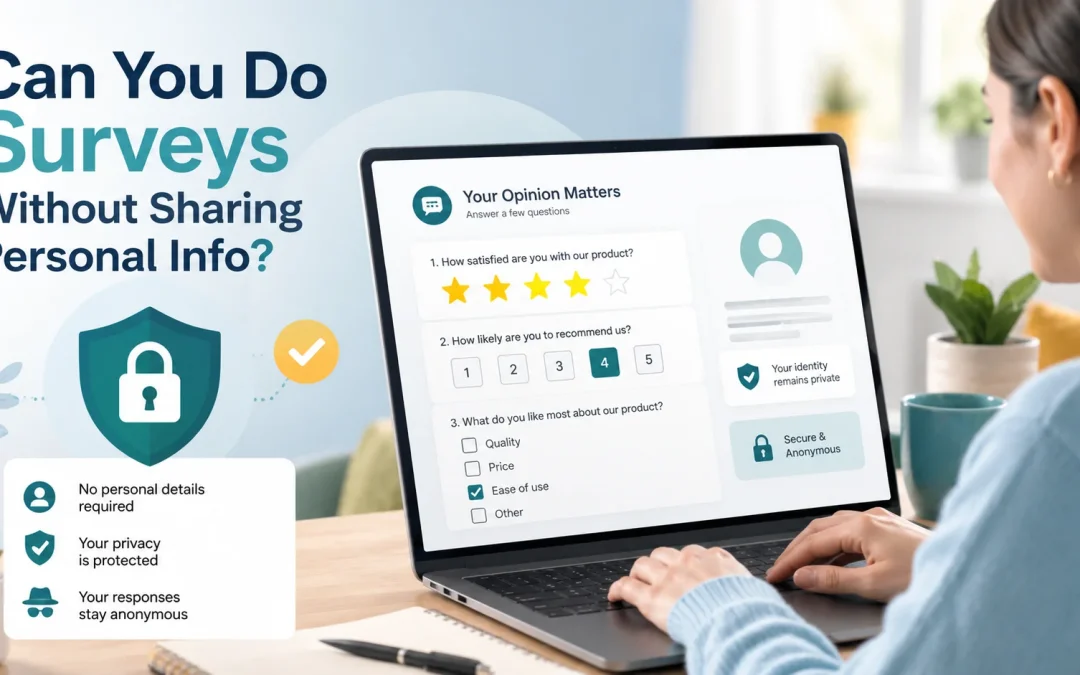
Can You Do Surveys Without Sharing Personal Info?
Yes, you can do some online surveys without sharing a lot of personal information, but your options and earnings will be limited. This approach is best for people who are privacy-focused, willing to earn less, and okay with getting fewer survey invites. It is not ideal for users who want to maximize earnings or qualify for high-paying studies, because those usually require detailed demographic data. Even on privacy-friendly sites, you will still need to share at least basic information like age, country, and payment details.
Many people want to make money from surveys but feel uncomfortable handing over their full name, address, or detailed profile. This article looks at how far you can go with “minimal info” while still getting paid. The focus is on paid survey sites specifically, not general data privacy tools, so you can decide if this trade-off is worth your time.
Table of Contents
- What Does “Personal Info” Mean for Survey Sites?
- Can You Do Surveys Without Sharing Personal Info?
- How Survey Sites Use Your Information
- Types of Surveys That Need Less Personal Info
- The Privacy vs Earnings Trade-Off
- How to Minimize Personal Info on Survey Sites
- Common Problems and Risks
- Who Should Avoid Sharing Too Much (and Who Can Share More)
- Alternatives to Traditional Survey Sites
- Frequently Asked Questions
- Summary: Is It Worth Doing Surveys Without Sharing Personal Info?
What Does “Personal Info” Mean for Survey Sites?
Basic vs sensitive information
Survey sites collect different levels of information. It helps to separate them into:
- Basic info: age, gender, country, language, general education level.
- Contact info: email address, sometimes phone number.
- Demographic details: income range, job title, household size, relationship status.
- Sensitive info: health conditions, political views, detailed financial data.
- Payment info: PayPal email, gift card account, or bank details (for some sites).
When people ask if they can do surveys “without personal info,” they usually mean avoiding real name, address, or sensitive data, not avoiding all information entirely.
What survey sites usually require at minimum
Most legitimate paid survey sites need at least:
- A valid email address (for account creation and payment).
- Your country and age (to check eligibility and legal requirements).
- Some basic demographic answers (to match you with surveys).
If a site claims you can earn money with absolutely no information at all, that is usually a red flag or a misunderstanding of how market research works.
Can You Do Surveys Without Sharing Personal Info?
Short answer: You can reduce, but not eliminate, personal info
You generally cannot earn from paid surveys without sharing any personal information. However, you can limit what you share to mostly basic and non-identifying details. This means:
- Using only your first name or a username where allowed.
- Skipping surveys that ask for highly sensitive topics you are not comfortable with.
- Choosing payout methods that do not expose your full banking details (for example, gift cards instead of direct bank transfer).
Who this approach is best for
Doing surveys with minimal personal info is best for:
- Privacy-conscious users who mainly want small rewards or gift cards.
- Beginners testing survey sites before committing more data.
- Teens or younger users under parental guidance, using privacy-friendly platforms.
If your main goal is to earn as much as possible from surveys, limiting your information will usually hold you back.
What you will likely have to share anyway
Even on the most privacy-aware survey platforms, you will almost always need to share:
- Your age and country (to comply with laws and target surveys).
- An email address that you actually control (for account recovery and payments).
- Some demographic categories like employment status or education level.
Without this, the site cannot match you to relevant surveys, and you will either get no invites or be disqualified constantly.
How Survey Sites Use Your Information
Why demographic data is necessary
Market research clients want feedback from specific groups, such as:
- Parents with young children.
- People in certain income brackets.
- Users of particular products or services.
Survey sites use your profile data to pre-filter who sees which survey. If you refuse to share most of this, the system cannot tell whether you fit the target group, and you will miss out on many opportunities.
How your data is typically handled
Legitimate survey panels usually:
- Aggregate responses so results are shown in groups, not individually.
- Separate your payment/account data from your survey answers.
- Use your profile data for targeting, not for selling your identity.
However, privacy policies vary, and some companies may share anonymized data with partners. Reading the privacy policy before signing up is important if you are cautious about data use.
Red flags to watch for
Be careful with survey or “get paid” sites that:
- Ask for your Social Security number or full tax ID upfront (unless it is a very high-earning, verified research company and you are in a country where tax forms are required after certain thresholds).
- Request credit card numbers or banking passwords.
- Promise extremely high payouts for very little work.
These are usually not standard requirements for normal paid survey sites and can indicate scams or data-harvesting schemes.
Types of Surveys That Need Less Personal Info
Short, low-paying consumer surveys
Many short surveys about everyday products or ads only need basic demographics. These often pay small amounts but do not require deep personal details. You might see questions like:
- “How often do you drink soda?”
- “Which of these brands have you heard of?”
- “How likely are you to buy this product?”
Opinion polls and general feedback
Some platforms run quick polls or one-question surveys that only need your age group and region. These are usually:
- Very fast to complete.
- Low paying or part of a points system.
- Less invasive in terms of personal questions.
Gift card–focused survey sites
Sites that mainly pay in gift cards may allow you to avoid sharing bank details. You still need an email and basic profile, but you can:
- Redeem codes directly to digital wallets or online stores.
- Avoid linking a bank account or full financial profile.
If you are specifically interested in gift card earnings, you may find it useful to look at resources like survey sites best for earning gift cards and compare how much information each one requires.
The Privacy vs Earnings Trade-Off
How limiting info affects your earnings
The less information you share, the fewer surveys you will qualify for. This usually leads to:
- Fewer invitations.
- More disqualifications at the start of surveys.
- Lower overall monthly earnings.
Survey sites rely on detailed profiles to match you with higher-paying, more specific studies. If your profile is mostly blank, you will be invisible to many of these opportunities.
Realistic earning expectations with minimal info
With a privacy-first approach, you should expect:
- Very modest earnings, often just a few dollars or small gift cards per month.
- More time spent trying to qualify compared to users with complete profiles.
- Occasional better-paying surveys, but not consistently.
For a deeper look at typical survey earnings and whether they are worth your time, it can help to read an analysis like pros, cons, and realistic earnings of paid survey sites.
When sharing more info might be reasonable
Sharing more detailed but still non-sensitive info can make sense if:
- You have tested the site and trust its reputation.
- You have read the privacy policy and understand how your data is used.
- You want to move from “occasional pocket money” to “more regular small side income.”
Even then, you do not need to share everything. You can still skip questions that feel too personal or irrelevant.
How to Minimize Personal Info on Survey Sites
Use a dedicated email address
Create a separate email account just for survey sites. This helps you:
- Keep survey-related messages away from your main inbox.
- Reduce the impact if one site has a data breach.
- Unsubscribe more easily if you stop doing surveys.
Limit profile details to what is necessary
When filling out your survey profile:
- Answer only required fields honestly but briefly.
- Skip optional questions that feel too intrusive.
- Avoid entering exact addresses unless absolutely needed for a specific, trusted study (for example, product testing that ships items to your home).
Remember that lying on surveys can cause issues, including bans or non-payment; if you are not comfortable answering, it is better to skip than to give false information.
Choose safer payout methods
To reduce the amount of financial information you share, you can:
- Use PayPal or similar services instead of direct bank transfers, if available.
- Opt for digital gift cards rather than physical checks that require a mailing address.
- Avoid any site that asks for credit card numbers just to join.
Stick to reputable survey panels
Well-known, long-running survey sites are more likely to handle data responsibly. Look for:
- Clear privacy policies and terms of service.
- Transparent information about how they pay and who they work with.
- Independent reviews and user feedback.
Lists of vetted platforms, such as legit paid survey sites that actually pay, can be a useful starting point when you want to balance earnings with privacy.
Common Problems and Risks
Too many disqualifications
If your profile is incomplete, you may start many surveys only to be screened out after a few questions. This leads to:
- Wasted time with no reward.
- Frustration and the feeling that surveys are not worth it.
Completing at least the basic demographic profile honestly can reduce this problem, even if you avoid more sensitive questions.
Spam and unwanted emails
Some survey sites and their partners send frequent promotional emails. Risks include:
- Inbox clutter and difficulty tracking real survey invites.
- Occasional marketing messages from third parties.
Using a dedicated email and adjusting notification settings can help manage this without giving up on surveys entirely.
Data breaches and privacy concerns
Any online account carries some risk of data exposure. With survey sites, the main concerns are:
- Leak of your email and demographic data.
- Potential phishing attempts if your email is exposed.
Using strong, unique passwords and enabling two-factor authentication where available can reduce the impact of such events.
Scam or low-quality sites
Not all “survey” sites are genuine market research platforms. Warning signs include:
- Upfront membership fees.
- Promises of extremely high income from simple tasks.
- Requests for sensitive data that is not needed for normal surveys.
Sticking to established, reviewed sites and avoiding anything that feels too good to be true is important if you want to protect your information.
Who Should Avoid Sharing Too Much (and Who Can Share More)
People who should be extra cautious
Some groups should be especially careful about what they share on survey sites:
- Teens and younger users, who should use only youth-friendly, vetted platforms and often under parental guidance.
- People in sensitive professions (for example, certain government roles) where detailed personal data could be more risky.
- Anyone who has experienced identity theft or is particularly vulnerable to scams.
People who might accept a bit more data sharing
Others may be comfortable sharing more non-sensitive details if the site is reputable:
- Adults with stable online habits and good security practices.
- Users who have tested a site for a while and trust its payment track record.
- People who want to qualify for more specialized, higher-paying surveys or focus groups.
Even then, it is reasonable to draw a line at highly sensitive information and to avoid sharing anything that feels unnecessary for the type of study.
Balancing privacy with your goals
Before signing up, ask yourself:
- Is my main goal maximum privacy, or slightly better earnings?
- What information am I absolutely not willing to share?
- How much time am I willing to spend for small rewards?
Your answers will help you decide how strict to be with your profile and which types of survey opportunities to pursue.
Alternatives to Traditional Survey Sites
Focus groups and higher-paying studies
Some people prefer fewer but better-paying opportunities, such as online focus groups or in-depth interviews. These often:
- Pay more per session than regular surveys.
- Require more detailed screening questionnaires.
- May ask for more personal or behavioral information.
If you are open to sharing more information in exchange for fewer but higher-value opportunities, you might explore options like those described in guides to making money by joining a focus group.
Microtasks and GPT (Get-Paid-To) sites
Some GPT platforms offer a mix of surveys, small tasks, and offers. From a privacy standpoint:
- They may require similar basic info as survey sites.
- Some tasks (like app installs or sign-ups) can involve sharing more data with third parties.
- You can choose to stick mainly to surveys and low-risk tasks.
Other low-information earning methods
If you want to avoid sharing personal info as much as possible, you might consider:
- Offline side gigs that do not require detailed online profiles.
- Simple local tasks or cash-based work.
- Methods where you control what you share, such as selling items you already own.
These are outside the scope of survey sites but may fit better if privacy is your top priority and survey earnings feel too low for the information you are asked to provide.
Frequently Asked Questions
Can I do surveys without giving my real name?
Some survey sites allow usernames or first names only, especially if they pay via PayPal or gift cards. However, certain platforms or higher-paying studies may require your real name for tax or verification reasons. If you are unsure, start with sites that clearly state they do not require full legal names for basic participation.
Do survey sites need my address?
Many standard survey sites do not need your full mailing address for regular online surveys. They may only ask for your country, region, or postal code to target local studies. A full address is usually only required for physical product tests or mailed checks, which you can choose to skip.
Can I get paid for surveys without sharing bank details?
Yes, many survey sites offer PayPal, digital gift cards, or other online payment options that do not require direct bank account access. You will still need to share an email or account ID for those services. If a site insists on bank details for very small earnings, it may not be worth the risk.
Are anonymous surveys really anonymous?
Many research surveys are “anonymous” in the sense that your answers are not tied to your name in the final data set. However, the survey platform itself still knows your account and demographic profile. True anonymity is rare; instead, focus on whether the site has clear privacy practices and does not share identifiable information.
Will I earn less if I skip personal questions?
In most cases, yes. Skipping many profile questions makes it harder for the system to match you with relevant surveys, which leads to fewer invites and more disqualifications. You can still earn something, but it will usually be lower than if you completed a fuller (but still honest) profile.
Is it safe for teens to do surveys?
Some survey sites are designed to be safer for teens, with age-appropriate content and clearer parental guidance. Teens should avoid sharing highly personal details and stick to platforms that explicitly allow under-18 users. Curated lists of teen-friendly survey sites can help identify better options.
Summary: Is It Worth Doing Surveys Without Sharing Personal Info?
You can do paid surveys while limiting how much personal information you share, but you cannot avoid sharing basic details like age, country, and an email address. This privacy-first approach usually means fewer surveys, more disqualifications, and lower overall earnings. It is most suitable for people who want small rewards and are more concerned about privacy than maximizing income.
If you are mainly looking for a serious side income, you will likely need to share more non-sensitive demographic data on reputable platforms. In that case, it helps to start with vetted lists of survey sites that actually pay real money and then decide how much information you are comfortable providing.
For most users, the best approach is a middle ground: use trusted survey sites, share only what is necessary and honest, and avoid any platform that asks for unusually sensitive data. Combine surveys with other earning methods, keep your expectations realistic, and treat survey income as a small, flexible supplement rather than a main source of money.

Madison researches legitimate ways to make money online, focusing on surveys, apps, and beginner-friendly income methods. Her goal is to provide clear, realistic guidance without hype.