
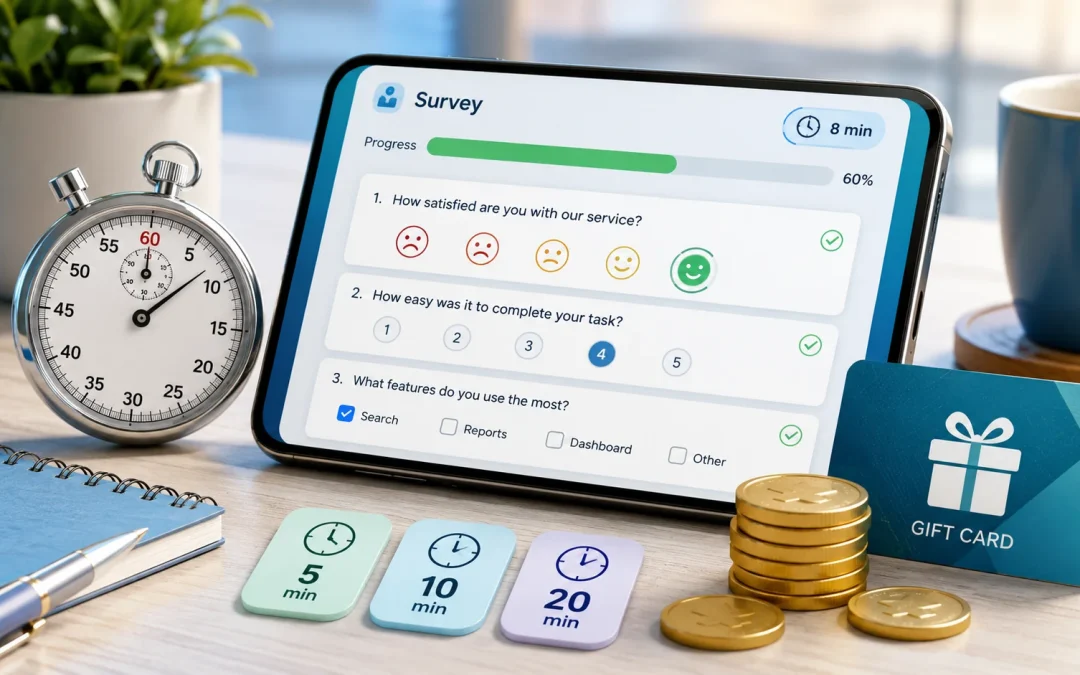
Most paid online surveys take between 5 and 25 minutes to complete, with a few very short ones under 5 minutes and some longer, in-depth surveys lasting 30–45 minutes. The time depends on how many questions there are, how complex they are, and whether you qualify for the full survey. A common misunderstanding is that all surveys are quick and highly paid; in reality, longer surveys usually pay more, but the hourly rate is still modest and you will not earn a full-time income from them.
Table of Contents
- Quick Summary
- What This Is
- How It Works
- Why It Works
- Common Misunderstandings
- Real-World Example
- Limitations
- Who This Helps
- Frequently Asked Questions
Quick Summary
- Paid surveys are online questionnaires that reward you with cash, gift cards, or points for sharing your opinions.
- Most surveys take 5–25 minutes, depending on length, complexity, and whether you fully qualify.
- They exist so companies and researchers can collect consumer feedback for product development and marketing decisions.
- A key limitation is that the pay per hour is usually low, and you may be screened out of some surveys after a few questions.
- Anyone considering paid surveys for side income should understand how survey length, qualification, and payout are connected.
What This Is
This article explains how long paid surveys actually take to complete and why the time can vary so much from one survey to another.
When you join a survey site, you are offered different questionnaires about products, services, ads, or your habits. Each survey lists an estimated time and a reward, such as points, cash, or a gift card balance.
Understanding survey length helps you decide which surveys are worth your time and what kind of hourly rate you are realistically earning.
How It Works
Step 1: You Join a Survey Site and Fill Out Your Profile
First, you sign up on a survey platform and create a basic profile with your age, location, gender, and interests.
Many sites ask additional questions about your job, household, and shopping habits. This information is used to match you with surveys that fit your demographic.
Some platforms also offer sign-up bonuses or quick profile surveys that take 2–10 minutes and pay a small amount.
Step 2: You Receive Survey Invitations With Time Estimates
Once your profile is set up, you start receiving survey invitations by email or inside your account dashboard.
Each invitation typically shows:
- An estimated time to complete (for example, 8 minutes, 15 minutes, 25 minutes).
- The reward (for example, $0.50, $1.50, or a certain number of points).
- The topic or general category (such as food, travel, technology, or finance).
These time estimates are based on test runs and averages from other participants, so they are approximate, not exact.
Step 3: You Start the Survey and Go Through Screening Questions
When you click on a survey, you usually begin with screening questions. These are short questions to check if you fit the target audience.
Screening might take 1–5 minutes. If you do not match the criteria, you may be “screened out” and returned to the survey site. Sometimes you receive a very small consolation reward; other times you receive nothing.
This screening time is part of your real time investment, even though it is not always counted in the survey’s official “time to complete.”
Step 4: You Complete the Main Survey Questions
If you qualify, you move into the full survey. This is where most of the time is spent.
Typical time ranges look like this:
- Short surveys: 3–7 minutes, often about a single product or a quick opinion poll.
- Medium surveys: 10–20 minutes, with several sections and more detailed questions.
- Long surveys: 25–40 minutes, often involving multiple product concepts, ads, or detailed behavior questions.
Your actual time can be shorter or longer depending on how quickly you read, how carefully you answer, and whether there are any technical delays.
Step 5: You Submit and Receive Credit
After you answer the final question and submit, the survey provider checks that your responses pass basic quality checks.
Most survey sites credit your account within a few minutes, but some may take a few hours or longer if the survey is part of a research project that needs extra verification.
Once you reach the minimum payout threshold, you can redeem your balance for PayPal, bank transfer, or gift cards. If fast cash-out matters to you, it is worth checking survey sites that offer quick PayPal payments.
Why It Works
Paid surveys exist because companies, brands, and researchers need reliable feedback from real people before they make decisions.
Instead of guessing what customers want, they pay market research firms to run surveys and analyze the results. These firms then recruit participants through survey sites and share part of the research budget with you as a reward.
Everyone involved benefits in a specific way:
- Companies and brands get data on what people like, dislike, or are willing to pay for, which reduces the risk of launching unpopular products.
- Market research firms earn fees for designing surveys, collecting responses, and providing insights.
- Survey platforms act as the middle layer, organizing participants, hosting surveys, and distributing rewards.
- Participants receive small payments or gift cards in exchange for their time and opinions.
Longer surveys usually pay more because they provide more detailed data, but the pay is still structured so that research remains affordable for companies.
Common Misunderstandings
People often misunderstand how survey length and earnings relate to each other.
Here are some common points of confusion:
- “All surveys are quick.” In reality, many worthwhile surveys are 15–25 minutes long. Very short surveys exist, but they usually pay less and may be less frequent.
- “The time estimate is always accurate.” Time estimates are averages. If you read slowly, think carefully, or face technical issues, your actual time may be longer.
- “Longer surveys always mean higher hourly pay.” Longer surveys pay more in total, but not always more per minute. Sometimes a 7-minute survey can pay better per hour than a 30-minute one.
- “You get paid for every minute you spend.” Screening time and disqualifications are often unpaid or lightly paid, which lowers your real hourly rate.
Understanding these points helps set realistic expectations and prevents frustration when a “10-minute” survey ends up taking 15 minutes or when you are screened out after a few questions.
Real-World Example
Imagine you log into a survey site on a Saturday afternoon with 45 minutes available.
You see three survey offers:
- Survey A: 6 minutes, $0.40 reward.
- Survey B: 15 minutes, $1.20 reward.
- Survey C: 30 minutes, $2.00 reward.
You decide to start with Survey B because the time and pay seem balanced. It takes 3 minutes of screening questions before you qualify, then 14 minutes to complete the main survey. Your total time is 17 minutes, and you earn $1.20.
Next, you try Survey A. Screening takes 2 minutes, but you are disqualified and receive $0.02 as a small consolation. You have now spent 19 minutes and earned $1.22.
Finally, you start Survey C. After 4 minutes of screening, you are disqualified with no reward. Your total session is about 23 minutes of actual survey answering plus 9 minutes of screening, for 32 minutes overall and $1.22 earned.
This example shows how the “official” survey times (6, 15, and 30 minutes) do not include all the time you spend, and how disqualifications affect your real hourly rate.
Limitations
Paid surveys have clear limits when it comes to time and earnings.
First, you cannot control how many surveys you receive or qualify for. Some days you may see several good options; other days you may see very few.
Second, the time you spend on screening and occasional technical issues is rarely fully compensated. This means your effective hourly rate is usually lower than it appears from the listed survey times and rewards.
Third, even if you focus on the best-paying surveys, the income is typically small. Surveys are better viewed as a light side activity rather than a main source of money. If you want to maximize what you earn from your time, it can help to focus on more reputable platforms, such as those listed in guides to paid survey sites that actually pay.
Who This Helps
Understanding how long paid surveys take is useful for several groups of people.
- New survey takers who want to know what to expect before signing up and how much time they should set aside.
- Busy students or workers who only have small time blocks and need to choose shorter surveys that fit their schedule.
- People tracking side income who want to calculate their real hourly rate and decide if surveys are worth their time.
- Anyone comparing survey sites who wants to focus on platforms that offer fair rewards for the time required. For a broader overview, you can review lists of legit paid survey sites that actually pay.
Frequently Asked Questions
How long do most paid surveys take?
Most paid surveys take between 5 and 25 minutes, with many common surveys falling in the 10–20 minute range.
Why do some surveys take so long?
Longer surveys usually cover more topics, ask more detailed questions, or test multiple product ideas or advertisements in one session.
Are the time estimates on survey sites accurate?
They are approximate averages. Your actual time can be shorter or longer depending on your reading speed, device, and any technical delays.
Do I get paid for screening questions?
Sometimes you receive a small consolation reward, but often screening time is unpaid, which reduces your real hourly earnings.
Is doing longer surveys worth it?
Longer surveys pay more in total, but not always more per hour. It is worth comparing the reward to the estimated time before you start.
Can I make a full-time income from paid surveys?
No. Paid surveys are best seen as a small side income or a way to earn gift cards, not as a replacement for a regular job.
Paid surveys are online questionnaires that typically take 5–25 minutes to complete, with time varying based on screening, question complexity, and survey length. While they offer a simple way to earn small rewards in your spare time, screening and disqualifications mean your real time investment is often higher than the listed estimate. If you understand how survey length, qualification, and payout interact, you can choose surveys more strategically and keep your expectations realistic. Used this way, surveys can be a modest but predictable side activity rather than a primary income source.

Madison researches legitimate ways to make money online, focusing on surveys, apps, and beginner-friendly income methods. Her goal is to provide clear, realistic guidance without hype.